


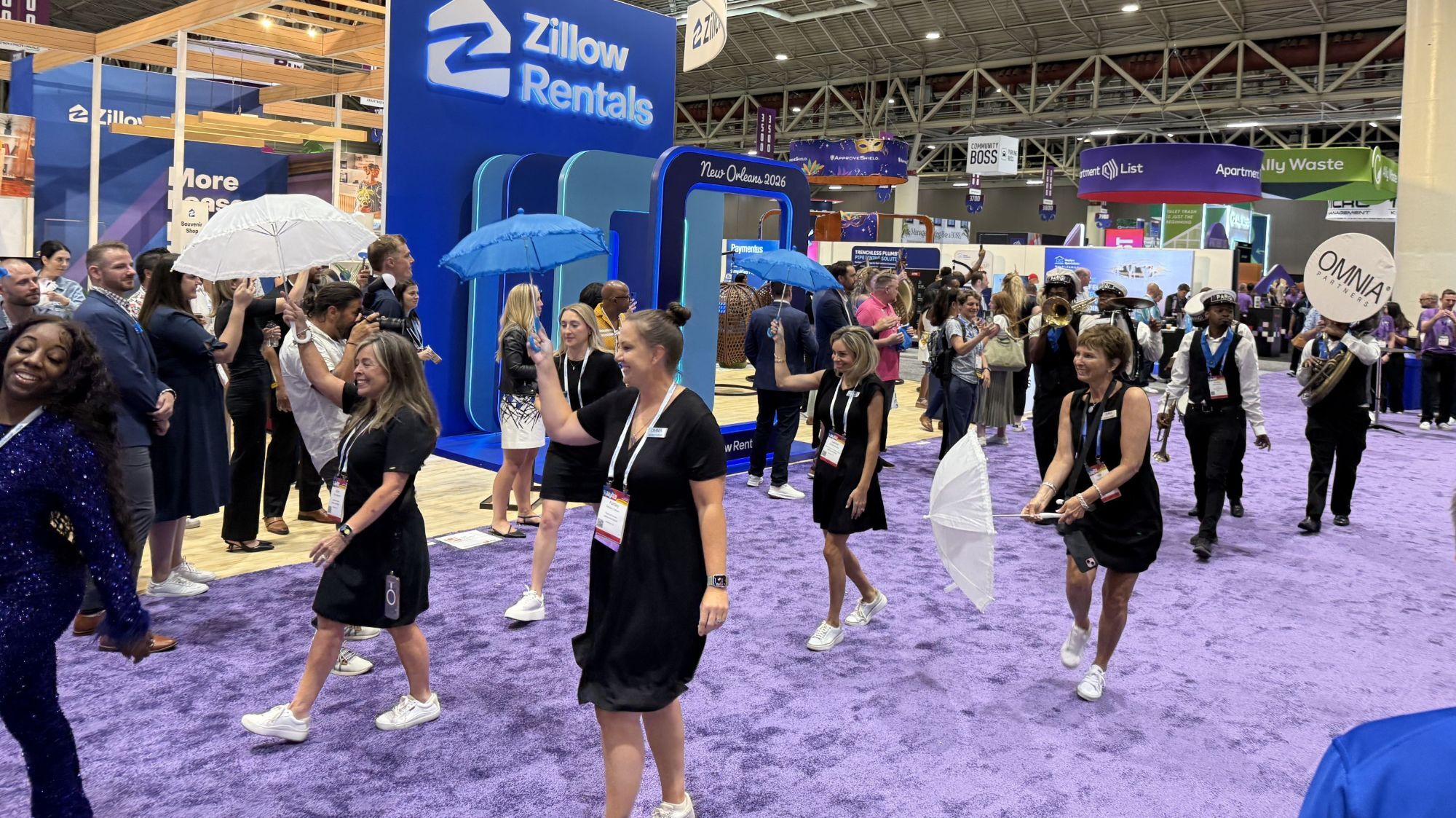
Today, NAA Apartmentalize wraps in New Orleans. It was a fun few days in the Big Easy, despite some particularly colorful summer weather. I could have done without the tornado warning early on Thursday morning, but that's life on the Gulf Coast!
As usual, the event provided a great opportunity for the industry to connect, and a few interesting themes emerged around operations and technology, which I summarize below.
Fee Transparency Is Entering the Mainstream
There is clear evidence that fee transparency is becoming embedded in multifamily marketing and leasing. An excellent session moderated by Zillow built on the previous (also very good) AIM panel on this topic.
Trust seems to be central to the findings. Greystar reported that 70% of properties rolling out transparent pricing saw increases in reputation score, with an average improvement of 18%. ILS conversion rates increased by 7% across the same properties.
Bozzuto shared fresh evidence that transparency generates better-qualified leads, as prospects understand what they can afford. They reported 38% fewer lease denials among applicants who were quoted a total price. Engrain shared interesting evidence of higher-intent engagement on property websites, such as higher page views, longer sessions, and stronger submission behavior.
A show of hands in the room suggested that about a third of attendees had already implemented transparent pricing at at least some of their properties. Although unscientific, the poll indicated that this approach is moving firmly into the mainstream.
There is still work to do. Greystar used the example of pet fees, which can now be incorporated into total pricing but still require manual selections to ensure those costs flow correctly through quotes, leases, and other documents. Bozzuto similarly observed that renters must still repeat the same pricing selections across ILSs, property websites and application processes. These gaps create friction and opportunities for error. But at this point, there is no denying the progress that companies have made over the past year.
Tech Term of the Show
Based on an entirely unscientific appraisal of my own conversations with suppliers, the tech word of NAA this year was “orchestration.”
I noticed the variety of suppliers using it to describe what their newest AI-driven product releases do, from resident communication workflows to integrations between applications to adding execution layers to analytics. I get it. It has a middleware ring to it, which is also why it’s hard to describe to a market that tends to think of tech in terms of feature functionality.
The AI Conversation Advances. Kind of.
AI, of course, received substantial attention at the show. Observing foot traffic on the trade show floor provided a useful data point on which value propositions are resonating.
One AI session presented by Yardi showcased tasks being automated through Claude. Cindy Fisher of Kettler shared some interesting statistics on invoice processing automation using an LLM alongside the PMS. The discussion focused on the time savings, as well as the security and change management considerations involved in introducing LLMs into processes like these.
There does, however, appear to be a gap in this conversation. Powerful as LLMs are, they are not the right solution to every AI problem. LLMs like Claude are non-deterministic: i.e., not designed to produce exactly the same output every time they receive the same input. That leaves an important role for purpose-built AI designed to perform specific tasks consistently, using proprietary data (rather than models predominantly trained on platforms like Reddit).
I’m not sure that delineation is well understood in the industry at the moment. Nor, I suspect, are the long-term costs, which are surprisingly absent from these discussions. To take the invoice example, the cost of making an API call to an LLM for every invoice will be a very expensive way to automate a process that is better handled by a dedicated model.
The escalatingly important topic of how we incorporate AI models into tech stacks will be the subject of a new podcast series I'll be releasing later this summer. We will be joined by some of the industry's leading AI providers and thought leaders to explore specific use cases, trade-offs and the architectural decisions behind them. Subscribe on your preferred podcast app or to our new YouTube channel to catch the episodes as they drop.
Affordable Is Having a Moment
I’ve been noticing more conversations about affordable housing: one session on strategies for leasing affordable properties gave a strong indication of why that is. As one might expect, the discussion focused on finding qualified renters. Building relationships with local housing authorities was central to that game plan, along with finding ways to speed up renter certification. That last point feels important.
It seems to be getting harder to lease affordable properties in many jurisdictions. Over the past few years, LIHTC developments have been relatively popular because they remained financially viable even in challenging market conditions. One consequence may be that a larger supply of affordable housing has changed competitive dynamics.
That is changing the importance of operational processes such as document collection and certification. With greater choice, income-qualified renters become less willing to tolerate slow, cumbersome certification processes. Affordability itself used to do most of the work of marketing affordable properties. If this session is any indication, attention is shifting toward improving the leasing process. It feels like a good time for suppliers to tackle some of the longstanding technology challenges facing affordable housing.
And Finally…. 😂
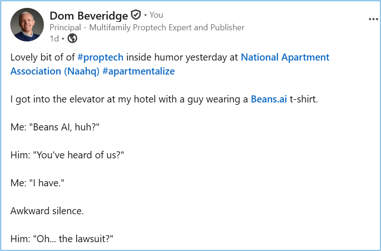
Finally, I'll end with a delightful moment of proptech humor and an important reminder that sometimes the universe writes your punchlines for you.
My thanks, as always, to NAA for organizing another energetic event. I look forward to seeing everyone in Denver for NAA Apartmentalize 2027.