


It's that time of year again. We're a few days away from RETTC OPTECH, the premier multifamily technology show of the year. As usual, we'll take a detailed look at this year's attendee list.
For those unfamiliar with our previous analyses, the logic is simple: OPTECH is the last opportunity of the year for buyers and sellers to meet and talk technology at scale. The more people a vendor sends, the more meetings it generally expects to have. Attendance is often conditional on booking a certain number of meetings in advance.
The breakdown of vendor attendees is therefore a useful proxy for what people are talking about at the industry's biggest technology event, and an important bellwether for where technology is going.
Let's break down the numbers.F
irst, a note on the data. Every attendee on the public OPTECH list is linked to a record in the 20for20 industry database. Assuming the published list is accurate, so is this analysis. The same methodology and database have been used for several years, making trend comparisons highly reliable.
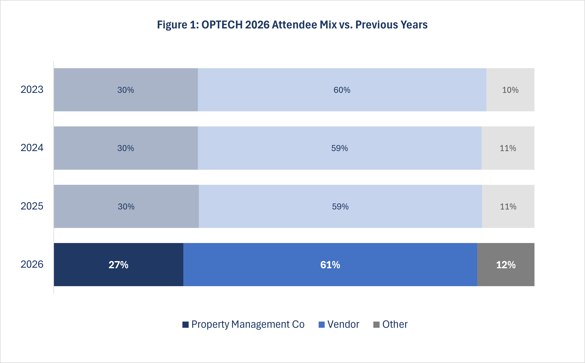
Figure 1 divides attendees into three groups: property management companies (PMCs), technology vendors and "Other"—a catch-all for consultants, trade associations, press, investors and non-core suppliers. This year, the shares of vendors and others increased by two and one percentage points, respectively.
For the first time, PMCs accounted for less than 30% of attendees, falling to 27%.Figure 2 provides context. Overall attendance appears to have declined slightly for the second consecutive year. Although attendee lists change constantly, each year's data was captured about five days before the event, allowing for meaningful comparisons.
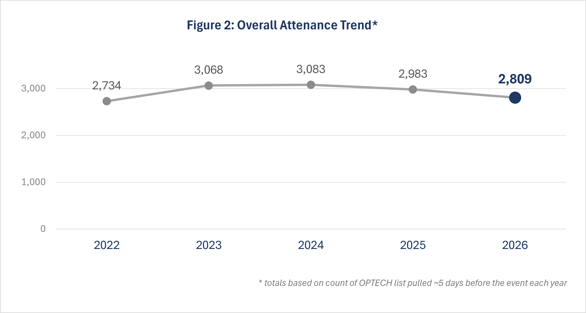
The move to a members-only event in 2025 may explain the slight decline in registrations. Meanwhile, the vendor-to-PMC ratio, historically around two to one, has shifted further in favor of vendors.
The Technology Breakdown
Figure 3 breaks down vendor attendees by technology category, using the same categories as last year. The headline is that fintech—including payments, deposits, screening and fraud prevention—accounts for the largest share of vendor attendees for the first time, growing 34% year over year. There is no obvious explanation: most companies attended last year but appear to have sent more people.
The same is broadly true of leasing and marketing, which also grew substantially. Other than the arrival of tour intelligence companies, the increase mostly reflects higher attendance from established vendors. Resident services is also up, albeit from a low base, possibly reflecting growing interest in ancillary revenue. More valet trash providers are attending, while resident apps are substantially less prominent this year.
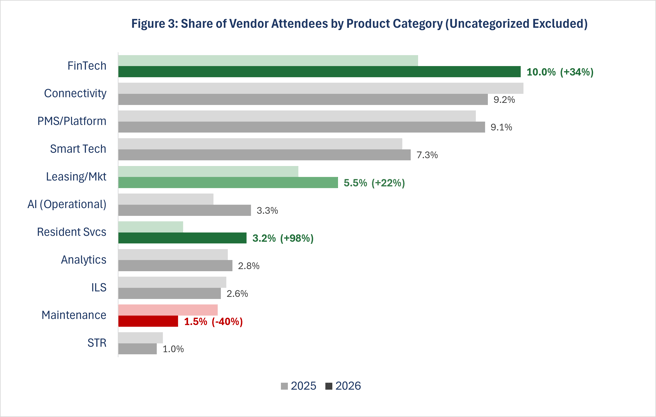
The notable decline is maintenance, with 40% fewer attendees than last year. OPTECH has increasingly looked less like a "maintenance show," and these numbers reinforce that impression.
Perhaps the most interesting observation, though, is harder to measure: an unusually high proportion of attendees appear to have changed jobs. Perhaps 10% of vendor attendees now represent different companies than a year ago. That suggests substantial hiring activity in multifamily technology, but also reflects the considerable uncertainty currently affecting the sector.
What to Do This Year
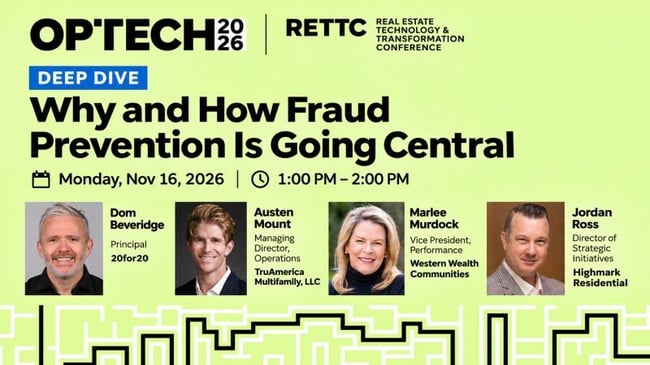
For those attending OPTECH, I recommend joining my session on Monday at 1 p.m., where we'll revisit one of multifamily's most interesting topics: fraud prevention, and how companies are changing the way they organize screening.
For several years, operators have implemented software to prevent fraudsters from entering properties. But as this year's 20for20 Annual Survey reported, experience is changing how operators understand the problem.
Reducing bad debt is different from simply defending against bad actors. It requires a broader view of the skills, incentives and technology needed to manage risk at the front end of the transaction. What once seemed primarily a technology and vendor selection problem is increasingly seen as an opportunity to build an enterprise capability.
Our panel, "Why and How Fraud Prevention Is Going Central" features three case studies: Jordan Ross of Highmark Residential, Marlee Murdock of Western Wealth Communities and Austen Mount of TruAmerica Multifamily. Each brings a different operating context and approach to the same problem.
As Marlee said during our preparation, if there's only one function you can centralize, it should be screening. I predict the development of this capability, whether done internally or through partners, will be a big area of focus for next year and beyond. Anyone of an operations or technology persuasion who is lucky enough to be attending OPTECH should join us on Monday at 1pm.
As usual, I'll write more after the show. In the meantime, I look forward to seeing as many of you as possible in Vegas.