
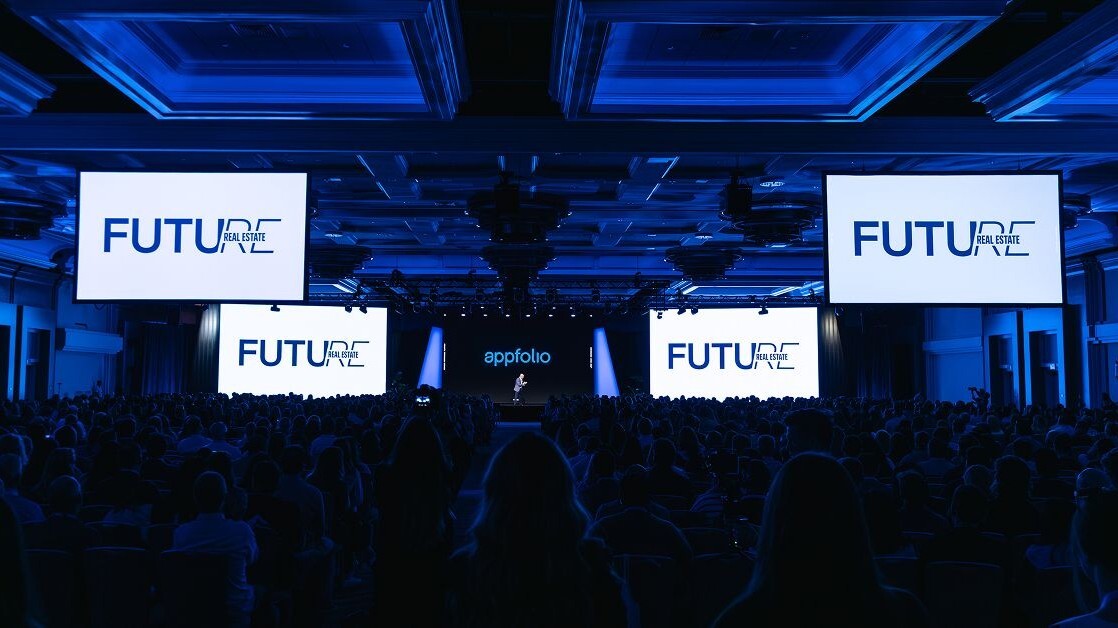
Another week, another conference in a fascinating fall series full of clues about how AI is progressing in property management. This week, it was AppFolio, marking its 20th anniversary with one of the biggest gatherings in property management at its FUTURE conference. As usual, it had a prevailing narrative. Also, as usual, that narrative is instructive about how this technology is progressing.
There was one marked difference between this year’s keynotes and those of the previous couple of years. Each of those events was defined by major product announcements that made AI increasingly central to the overall user experience. This year the focus was mostly on adoption. The show had an evangelical zeal, using many user case studies to demonstrate how users are transforming their businesses, encouraging everybody else to get on board. It makes sense in the context of what happened over the last couple of years.
A little bit of history
Two years ago, “RealmX” launched, ushering in the era of prompt-based property management. Last year, “Real Estate Performance Management (RPM)” moved AI up the value chain, with “performers” (AI agents) that enable users to set performance objectives and have the AI plan how to accomplish them. The software can “do the work” (another often-repeated phrase), so its real leverage lies in users being willing to delegate more activities to the technology. And therein lies an interesting nuance that presenters worked hard to clarify throughout the event.
In his keynote, CEO Shane Trigg talked about the “efficiency trap,” where AI capabilities lead to people doing more things because AI can do them more efficiently. While that capacity is, of course, useful, executing more processes may or may not lead to better performance. The task-based focus of early adopters risks missing the point of AI, which explains the natural progression to RPM a year ago.
There is an underlying thesis beneath all of the use cases we saw in the presentations: each step in any process represents some kind of performance opportunity that the AI-enabled technology can unlock. As the keynote progressed, it gave the impression that this is where AppFolio is placing its bet. The value proposition, as described in the session, is about identifying and locking in performance upside, after which it compounds over time as automation locks the improvement into the operating platform.
When the techies preach
There was plenty of new eye candy on show at the (separate) technology keynote, where Matt Baird, the CTO, and his team shared expansive views of how companies are using the technology in real life. Words like trust were prominent in a highly narrative-driven (and very well-executed) presentation that seemed designed to turn technological capability into something closer to belief.
The idea of focusing people on what they do best and leaving technology to do the grunt work is not new. But here AppFolio’s technology leadership was preaching the need for a reset in the relationship between workers and their technology. The challenge is no longer just to deliver the technology, but to convert users to a different way of working.
“Your best people are your best people, and clearing queues was not what made them great,” was one example from Baird’s presentation. “The next big thing is probably not another screen. It’s likelier to be permission not to have to look at one,” was another.
The case studies that followed were admirably detailed, making it clear how companies are grasping the opportunity of automation. RealmX Performers, like “Leasing Performer,” got extensive coverage, showing how operators reimagine complete end-to-end processes, like search all the way through to move-in, with the software effectively configuring itself to deliver what the property manager wants.
A personal favorite feature of mine was when Teddy Ho, Director of Product for AI, showed how a property manager can drag and drop a standard operating procedure document into RealmX, which then automatically converts the SOP into a workflow in the software. We have come a long way since the days when a workflow had to be designed, built and configured into the software!
Why this makes sense now
Among AI platforms, AppFolio has something of a canary-in-the-coal-mine quality. They are further along in this journey than the other major PMS platforms, so their trajectory holds learnings that are generally applicable.
They were earlier in re-architecting their platform for AI than other established PMSs. Their main client profile (smaller operators) represents a simpler set of business processes than the institutional-grade multifamily portfolios that make up a higher proportion of the other PMS vendors’ user bases. It collectively means that they have moved faster, and today have the most coherent vision and execution of an AI-enabled property management system.
Now they need more customers to reap more benefits. In an environment where new competitors are rising and the competitive backdrop is shifting, adoption becomes the most powerful competitive differentiator. Technology becomes indispensable when it effectively runs large parts of its users’ businesses.
The three-year arc has moved from executing tasks to executing entire processes and guiding decisions, to embedding the capabilities throughout the user base. The evangelical zeal of the presentations reflected the imperative: AppFolio has built the technology; now it needs to convert as much of its user base as possible to this radically different way of managing properties.
As usual, the execution of the event was first-class. Lisa Horner and her industry-leading marketing team delivered an excellent experience and look and feel. I always find myself enjoying the graphical elements of FUTURE, and this year’s event delivered once again. Well done, all!