
Each year, the release of the 20for20 Annual Survey generates fresh perspectives on what is happening in the multifamily industry. Beyond the paper’s focus on leaders of operations and technology, it is from reviewing findings with institutional owners, technology company founders and investors, for example, that some of the most interesting ideas emerge.
One such conversation developed last week at the inaugural “Multifamily Powder Mastermind,” an amusingly titled retreat for multifamily professionals hosted by my friends at Verifast. The event featured multiple après-ski deep dives into this year’s 20for20 findings, developing an understanding of how the prevailing trends affect this group.
One topic that has emerged since the paper’s publication got considerable airtime at this retreat. It concerns what might happen after centralization.
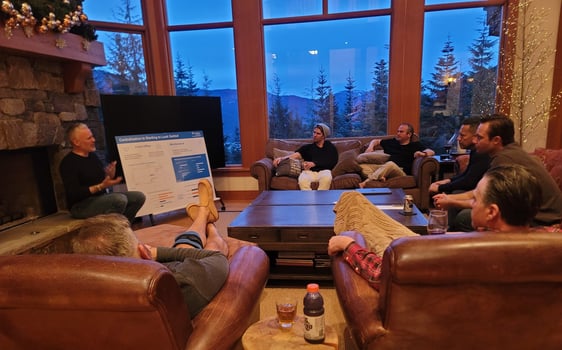
Après-Ski Conversation at the Multifamily Powder "Mastermind"
A Confluence of Trends
To set out a couple of important points (without rehashing too many details from the paper): multifamily has been pursuing centralization for several years. The objective is to remove work and roles from properties and replace them with more efficient centralized processes. While all functions, including leasing and maintenance, have been in scope, it has been property admin (i.e., the work usually done by assistant community managers) that accounts for most of the progress.
As this year’s paper points out, the model is starting to look settled. While technology has improved leasing and maintenance, both functions remain staffed much as they were before this trend began. Administrative tasks have moved off-site, which makes sense as those tasks were never a great fit for the constant interruption of the leasing office.
One thing seems common to the operators centralizing successfully: they are usually the ones who have focused on moving the work rather than moving the roles. While there was much early excitement about before-and-after org charts, the companies seeing the best results focused on reimagining how processes should work. When the process is right, the range of possible staffing models becomes obvious.
Many in our industry find it more helpful to think of this trend as specialization, rather than centralization. Having smaller, specialist teams handle accounting, screening, or collections, for example, can deliver greater efficiency and greater leverage from automation than could be achieved through individual property teams.
Those are the same benefits that typically lead companies to outsource processes to partners. Once work is redesigned to be addressed by specialist teams, it matters less whose staff are performing these roles.
The Growing Appeal of Outsourcing
There are already examples of how outsourcing can work in “centralized” environments. AvalonBay has been running back-office functions for Gables for almost three years. Our hosts for this event, VeriFast, have responded to the growing customer requirement to remove screening from properties by offering centralized screening as a service. Operators have been outsourcing revenue management services for many years.
A more interesting example came from one of the ownership groups participating in this retreat. This company has no desire to be a vertically integrated owner-operator, but has taken all administrative functions out of the scope of their third-party management agreements, moving the work previously done by ACMs to a specialist offshore admin team.
The benefits of this approach are clear. Consistency, reporting, degree of control, and compliance with a single technology stack—specific to the owner rather than the operator—are all attractive to a capital-intensive business. Rather than changing the delivery model for property management, it effectively takes some of the requirements out of scope altogether.
The Important Question of “Who?”
A little over a year ago, a 20for20 paper, “Centralization for Third-Party Management,“ described how it is harder than it is for owner-operators for a couple of reasons. First, it involves changing property management agreements so that, rather than billing back the cost of an individual team member, the owner must agree to purchase services from the operator’s central team. For reasons described in detail in the paper, that is a relatively complex commercial decision.
Second, third-party operators are limited in how they can redesign services. They have central teams that must cover the needs of a diverse customer base (rather than a single owner). And for each property, participating in central services entails replacing 100% of a team member with central services, making it an all-or-nothing proposal for owners.
Even with strong central service offers, there is uncertainty over how many clients will adopt them, as well as the perpetual movement of properties in and out of management portfolios. This year’s 20for20 Annual Survey noted the widely varying uptake of third-party managers’ centralized admin offers. All of this raises an interesting question. If administrative tasks lend themselves to being executed by specialist teams, is the operator the best party to perform them?
We have always thought of property accounting, collections, and so on as part of the scope of property management. But as those tasks continue to disappear from the leasing office, they move further from the core competencies of property management, which are mostly about delivering living experiences.
The motivations to improve process efficiency and outcomes are obvious and largely account for the progress operators have made in centralizing functions over the last few years. They are the same forces that have driven outsourcing decisions for decades. The model for centralization is looking settled, as this year’s Annual Survey reported. But as centralized processes become increasingly routine, attention may turn to who can perform them the most efficiently.

Photo by Jan van der Wolf on Pexels