---
title: "Nudge: A New Tactic in Renewal Pricing"
description: Renewal pricing focuses on the price point of the offer. But a growing number of operators are finding that incentives can drive some helpful behaviors
image: https://blog.20for20.com/hubfs/Nudge%20-%20A%20New%20Tactic%20for%20Renewal%20Pricing.jpg
---
[](https://20for20.com)
 
Open main menu Close main menu
- [About](https://20for20.com/about/)
- [The Annual Survey](https://20for20.com/annual-survey/)
- [Pod](https://20for20.com/tech-talk-with-20for20-podcast/)
- [Press & Media](https://20for20.com/press-and-media/)
- [Blog](https://blog.20for20.com/blog)
- [Contact Us](https://20for20.com/contact/)
# Nudge: A New Tactic in Renewal Pricing
Published : September 17, 2026

Multifamily operators have never focused as much attention on renewals as they have on new leases. That is an uncontroversial view, irrespective of renewal decisions accounting for more than half of most communities’ revenue. The most obvious case for this gap is marketing. A less obvious, but still important one, is revenue management (RM).
In our industry, RM algorithms use data about the demand and supply for a property to determine the market rate for new leases. Renewals have always been *downstream* of that pricing recommendation. The main renewal pricing decisions concern whether or not to price them consistently with new rent pricing, which is a human, not an algorithmic decision.
There are, of course, good reasons for that. The rent that each resident is currently paying was determined by the circumstances almost a year earlier, so not everyone is paying the same rent. Each resident’s current rent may be higher or lower than current market rent, so renewal offers must be considered in relation to that price *difference*.
For these reasons, considerable analysis, discussion and emotion has always gone into determining the price point of the renewal offer. But a new variable is coming into the equation: the impact of pricing *incentives* upon renewal decisions. That requires us to get into the fascinating overlap between pricing and behavioral dynamics. Let’s do it.
**A New Lever**
Renewal pricing has generally been a static exercise, where a renewal price is set, occasionally resulting in a negotiation. A better approach structures the process around time-sensitive, “*tiered,*” price offers. That introduces urgency, as the resident sees clear timelines and implications for delaying their decision.
This strategy assumes that getting people to make renewal decisions early is a good idea. Our recent paper, [*“What Renewals Can Be,”*](https://lp.20for20.com/20for20-what-renewals-can-be)explains how reducing the number of residents leaving it late to make renewal decisions increases lead time for things like re-marketing units and planning turns. But as the paper also argues, early decisions carry the advantage of taking the resident out of the market for competitor communities, and thereby improving renewal likelihood.
As with all incentives, the key is to make the tactics deliver the outcomes that we want. Figure 1 illustrates the economic principle behind time-sensitive offers. The maximum incentive (lowest price) is offered to residents early on because it resolves real uncertainty and locks in a renewal that the property might otherwise lose. Closer to the deadline, the resident has either already decided or run out of other options, so there is no point in offering the incentive, and price moves to its highest point. The strategy concentrates incentives early and lets their value taper off for those who wait.
*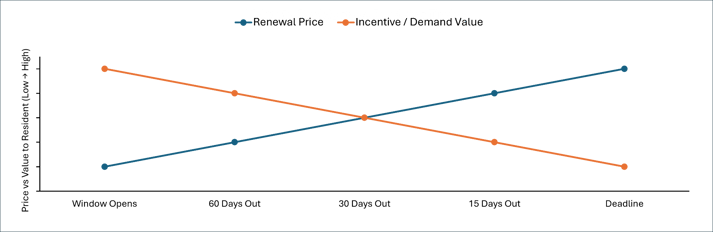*
Figure 1: Renewal Price and Value Over Time
This is different from normal discounting in an important way: rather than reducing rent to persuade residents to stay, the initial offer reflects the market rent available at the time it is made. As the decision is delayed, the operator incurs increasing costs through reduced planning certainty, compressed leasing timelines and the greater risk of vacancy. Subsequent price increases therefore compensate for that growing cost of uncertainty.
Residents remain free to decide when to renew, but they also understand the financial consequences of waiting. The result preserves pricing integrity while aligning the renewal offer with the economic value of an earlier decision.
There is strong evidence to suggest that it works: Figure 2 shows a comparison of average decision times across a sample of 175,000 renewal offers (provided by Renew). When the decision time is characterized relative to the day the offer was sent, residents decided on time-based offers after 21 days, compared to an average of 29 days without the time element.
*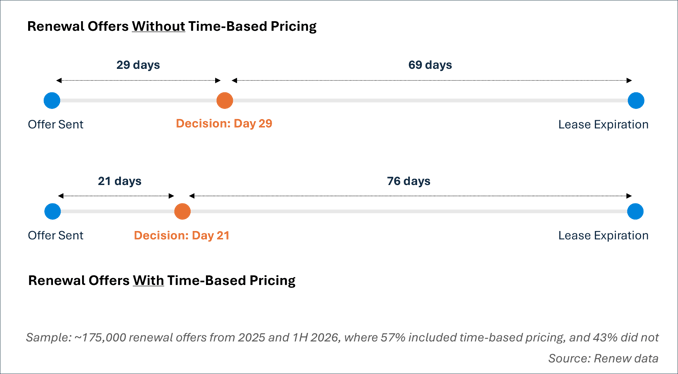*
Figure 2: Comparison of Decision Times With and Without Time-Based Pricing
That is a strong indication that residents are responding to a specific time-based offer. But as any revenue manager knows, pricing incentives create value only if they do not come at the expense of demand. In this example, the earlier decisions illustrated in this example are accompanied by higher renewal rates. Renewal offers with time-based pricing achieved an acceptance rate of 65.4%, compared with 62.7% for offers without time-based pricing. Earlier decisions do not appear to come at a cost to renewal rates.
Much of the operational benefit to earlier renewals comes from reducing uncertainty. A useful way to frame it is how many undecided lease decisions survive through to expiration. Figure 3 compares the proportion of offers that are undecided at 60, 30 and 15 days prior to lease expiration.
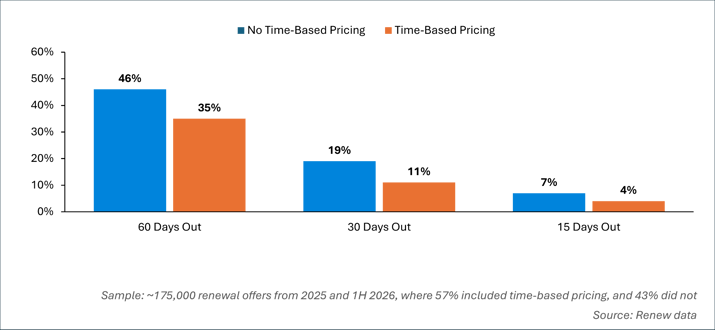
Figure 3: Share of Renewals Undecided Between Renewal Offer and Lease Expiration
At 60 days (the most common point for a pricing deadline in this sample), 11% fewer residents are undecided about their renewal decision. As lease expiration approaches, the cohort without a deadline naturally catches up; but at 30 days, there is still a substantial gap (8%) between the cohorts. Even at 15 days, which is close enough to move out to constitute an operational risk, the gap remains.
Based on this evidence, time-based pricing offers do a couple of important things. They reduce the number of operational emergencies caused by late decision makers, and they bring medium-term predictability to the management of the business. The substantially clearer picture at 60 days, illustrated in Figure 3, supports better forecasting and hence better pricing and marketing decisions.
To tie this to the earlier point illustrated by Figure 1, the value to the operation of securing early decisions makes the incentives worthwhile, provided the operational discipline is in place to manage the program.
There is a general observation here, that comes out throughout our recent white paper: Renewals are more predictable and manageable than we tend to think they are. The relatively small modification to pricing strategy demonstrated above has a useful impact on decision timeframes. The greater predictability enables better pricing, marketing and operational decisions, and so on.
These and other emerging tactics are described in “[What Renewals Can Be](https://lp.20for20.com/20for20-what-renewals-can-be).” Download your free copy now if you haven’t done so already!
[](https://hubspot-cta-redirect-na2-prod.s3.amazonaws.com/cta/redirect/21325574/c93403de-7adc-40c5-896b-76d3801a4020)
#### ALL BLOG CATEGORIES
- [Multifamily Executive Insights](https://blog.20for20.com/blog/tag/multifamily-executive-insights)
- [Multifamily Technology Trends](https://blog.20for20.com/blog/tag/multifamily-technology-trends)
- [Multifamily Industry Events](https://blog.20for20.com/blog/tag/multifamily-industry-events)
- [Multifamily Revenue Management](https://blog.20for20.com/blog/tag/multifamily-revenue-management)
- [Centralization](https://blog.20for20.com/blog/tag/centralization)
- [Multifamily Leasing & Marketing](https://blog.20for20.com/blog/tag/multifamily-leasing-marketing)
- [Property Management Automation](https://blog.20for20.com/blog/tag/property-management-automation)
- [Multifamily AI](https://blog.20for20.com/blog/tag/multifamily-ai)
### Subscribe to Our Blog
### Related Blogs
[Multifamily Executive Insights](https://blog.20for20.com/blog/tag/multifamily-executive-insights)
[Multifamily Revenue Management](https://blog.20for20.com/blog/tag/multifamily-revenue-management)

Got a great technology idea that you want to share? Need help connecting with the market or describing what you do? We can probably help.
[mailto:dom@20for20.com](mailto:dom@20for20.com)
Copyright ©2022 TFT Consulting, LLC.
- [About](https://20for20.com/about/)
- [The Annual Survey](https://20for20.com/annual-survey/)
- [Pod](https://20for20.com/tech-talk-with-20for20-podcast/)
- [Press & Media](https://20for20.com/press-and-media/)
- [Blog](https://blog.20for20.com/blog)
- [Contact Us](https://20for20.com/contact/)
```json
{
"@context" : "https://schema.org",
"@type" : "BlogPosting",
"author" : {
"@type" : "Person",
"name" : "Dom Beveridge",
"url" : "https://blog.20for20.com/blog/author/dom-beveridge"
},
"dateModified" : "2026-09-17T11:30:00.113Z",
"datePublished" : "2026-09-17T11:30:00.000Z",
"headline" : "Nudge: A New Tactic in Renewal Pricing",
"image" : [ "https://blog.20for20.com/hubfs/Nudge%20-%20A%20New%20Tactic%20for%20Renewal%20Pricing.jpg" ],
"mainEntityOfPage" : {
"@id" : "https://blog.20for20.com/blog/nudge-a-new-tactic-for-renewal-pricing",
"@type" : "WebPage"
},
"publisher" : {
"@type" : "Organization",
"logo" : {
"@type" : "ImageObject",
"url" : "https://blog.20for20.com/hubfs/Dom-White-Transparent-1.png"
},
"name" : "TFT Consulting, LLC"
}
}
```